> For the complete documentation index, see [llms.txt](https://relationlabs.gitbook.io/protocol/llms.txt). Markdown versions of documentation pages are available by appending `.md` to page URLs; this page is available as [Markdown](https://relationlabs.gitbook.io/protocol/protocol-zh/integrations/quick_start_index.md).
# 构建Relation Protocol社交图谱
这里将介绍如何快速构建一个 graph-indexer监听链上数据,利用neo4j图数据库存储RDF数据、查询并展示图谱。
## 环境依赖
开始本教程之前,您的计算机上必须安装[Node.js](https://nodejs.org/en/)。
## 部署 neo4j
参考[该文档](https://docs.relationlabs.ai/protocol/indexer/build-graph)中的 neo4j 部分
## 一个简单的 Graph Indexer
这里我们使用 nodejs & neo4j-driver 来完成。
> 本示例将会监听 Goerli 网络上 8701627 至 8702627 区块的 RDF 数据。
1. 新建一个项目,安装 neo4j-driver ethers(v5) 库
```shell
mkdir graph-indexer
cd graph-indexer
npm init -y
npm install neo4j-driver ethers@5
```
2. 监听链上数据,创建一个 app.js,内容如下:
```javascript
const ethers = require('ethers')
const rpc = 'https://rpc.ankr.com/eth_goerli'
let abi = ['event CreateRDF(uint256 indexed tokenId, string rdfStatements)']
const provider = new ethers.providers.JsonRpcProvider(rpc)
const iface = new ethers.utils.Interface(abi)
const filter = {}
// connect neo4j-server
const neo4j = require('neo4j-driver')
const uri = 'bolt://localhost:7687'
// neo4j默认的 用户名/密码 为 neo4j/neo4j
const user = 'neo4j'
const password = 'neo4j'
const driver = neo4j.driver(uri, neo4j.auth.basic(user, password))
const session = driver.session()
// 将rdf插入neo4j
async function insertRdfToNeo4j(rdfString) {
const session = driver.session()
try {
const result = await session.run(
`CALL n10s.rdf.import.inline("PREFIX :
PREFIX p:
prefix rdf:
prefix xsd:
prefix rdfs:
${rdfString}","Turtle");`
)
return result
} catch (error) {}
session.close()
}
// 监听链上所有新的事件
provider.on(filter, async (e) => {
try {
let event = iface.parseLog(e)
if (event) {
const rdf = event.args[1]
// 解析
// todo: 做自己的业务逻辑,可以筛选自己需要的RDF数据
// 入库
const res = await insertRdfToNeo4j(rdf)
}
} catch (error) {}
})
// 也可以获取指定filter的数据
const logFilter = {
fromBlock: 8701627,
toBlock: 8702627,
topics: [
utils.id("CreateRDF(uint256,string)"),
]
}
provider
.getLogs(logFilter)
.then(function (logs) {
for (let index = 0; index < logs.length; index++) {
try {
const log = logs[index]
const event = iface.parseLog(log)
if (event) {
const rdf = event.args[1]
insertRdfToNeo4j(rdf)
}
} catch (error) {}
}
})
.catch(function (err) {
console.log(err)
})
```
3. 运行 Graph Indexer 程序
```shell
node app.js
```
等待数据插入后,在浏览器打开[http://localhost:7474/browser/](http://http://localhost:7474/browser/),输入框中输入`match (n) return n`即可查询到所有数据
如果需要查询所有follow关系,可以输入
```shell
MATCH (node1)-[rel:p__following]->(node2)
RETURN node1,node2
```
将看到以下图谱:
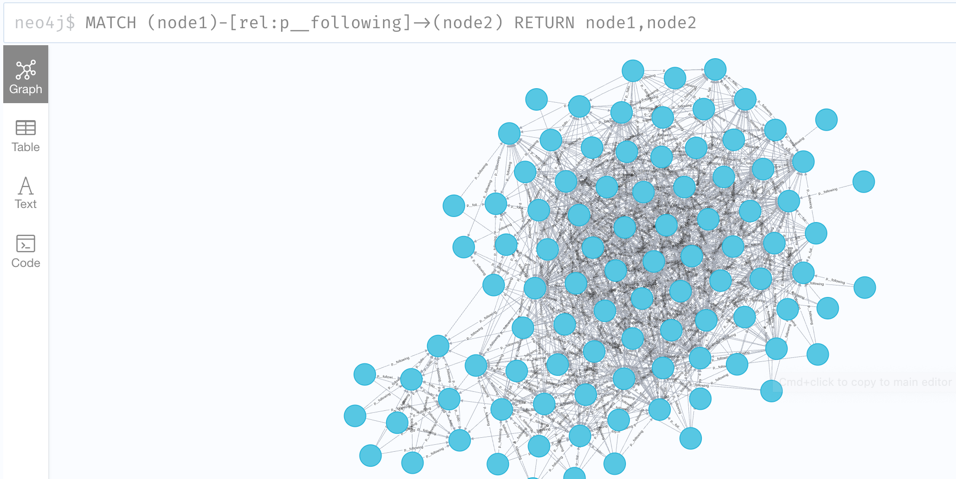
图 8-1 Social Graph